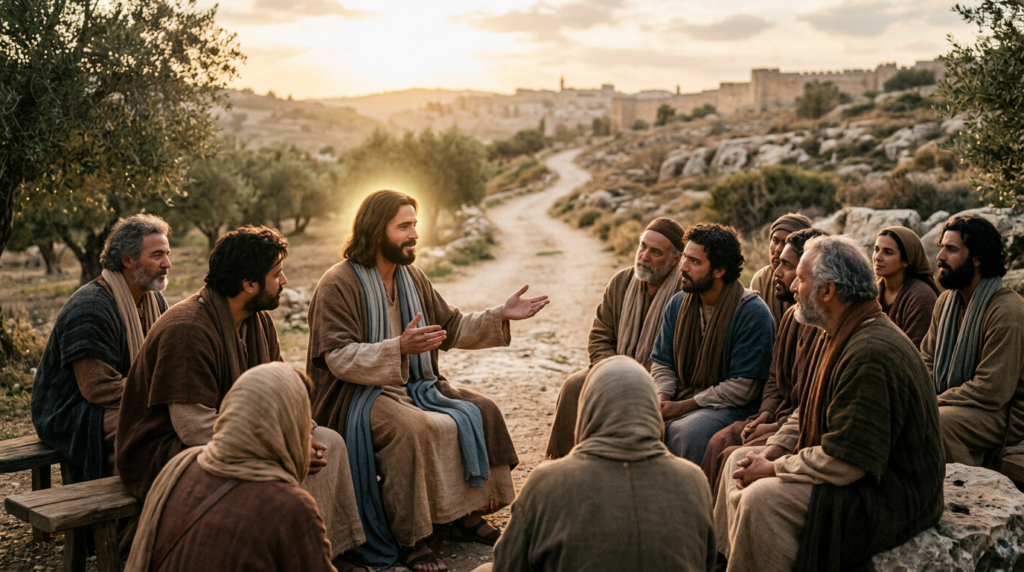
What is this all about:
“Jesus once said somewhere along those lines, ‘I am the way. Be this way by the example of I am this way. Be like me not by merely following me, by being me, by being it’”.


That’s not an actual quotation from the Gospels — it reads like a modern, mystical paraphrase of John 14:6, where Jesus says: “I am the way, and the truth, and the life; no one comes to the Father except through me.” The extra material (“be this way by being me, by being it”) is someone’s interpretive expansion, and it belongs to a recognizable tradition of reading that verse.
The interpretive question underneath is old and genuinely interesting: does “I am the way” mean Jesus is a gate you pass through (believe in him, follow his teachings, and you’re saved), or does it mean his way of being is itself the way — something you’re meant to embody rather than merely admire from a distance? Your paraphrase takes the second reading and pushes it further into what you might call participatory or nondual territory: not imitation of Christ but identification with Christ.
That push has deep roots, even in mainstream Christianity. Eastern Orthodoxy has the doctrine of theosis — Athanasius’ famous line that “God became man so that man might become god.” Paul writes “it is no longer I who live, but Christ lives in me” (Galatians 2:20).
Medieval mystics like Meister Eckhart went furthest, preaching that the birth of the Son happens in the soul, that at the deepest ground there’s no distinction between the soul and God — which got him posthumously condemned on several counts, precisely because “be me” sounds different from “follow me.”
There’s also a strand that connects Jesus’ “I am” statements to Exodus 3:14, where God names himself “I AM THAT I AM.” Mystical and esoteric readers (from certain Christian contemplatives to New Thought writers like Joel Goldsmith) take Jesus’ “I am the way” as pointing not to the historical man primarily, but to the divine “I AM” — pure being — which is present in everyone, and which Jesus fully realized. On that reading, “be it” means: wake up to that same ground in yourself.
Traditional Protestant and Catholic theology mostly resists this — it holds the line that Christ is unique, and that we’re conformed to his image by grace, not identical with him. So your paraphrase sits at the mystical edge of the tradition rather than its center. But it’s not made up out of nothing; it’s a compressed version of a debate Christians have been having for nearly two thousand years about what “the way” actually asks of a person.
Do you remember where you encountered that phrasing? Knowing the source would help pin down which tradition it’s coming from.
Leave a Reply